
A brush cutter is a motorized tool designed to cut dense vegetation that lawn mowers cannot reach: brambles, tall grasses, undergrowth, irregular borders. The choice of the right model depends on three interrelated technical parameters: the type of motorization, the cutting system, and the configuration of the terrain to be maintained.
Noise level and local regulations: a often overlooked selection criterion
Before comparing the power or price of a brush cutter, one constraint deserves to be addressed first: the hours of use vary from one municipality to another. In France, the authorized time slots for noisy tools are governed by municipal or prefectural orders, not by a single national rule. The general principle remains the prohibition of noises disturbing the tranquility of the neighborhood due to their duration, repetition, or intensity.
This point weighs on the choice of motorization. A petrol brush cutter produces a significantly higher noise level than a battery model. For use in dense residential areas, near schools, or in city centers, local authorities are increasingly incorporating noise levels and low emissions into their requirements. A comprehensive catalog of machines suitable for these constraints is available at debroussailleuse-warrior.com, which lists both petrol and battery models.
In practical terms, if your terrain is small and located in a housing development, a battery machine gives you scheduling flexibility that petrol models do not always allow.
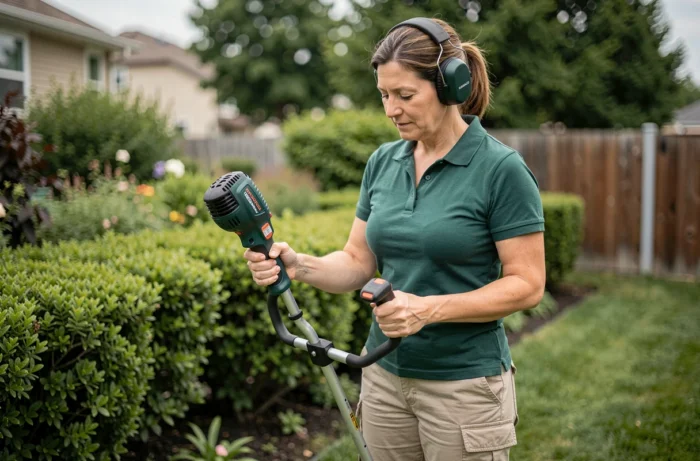
Brush cutter motorization: petrol, battery, or electric corded
The motorization determines both the available power, autonomy, and weight of the machine. Each type meets a specific use.
Petrol brush cutter
The gasoline engine (two-stroke or four-stroke) offers the highest power. It is the suitable choice for large areas, thick brambles, and woody undergrowth. The downside: a higher weight, regular engine maintenance (spark plug, filter, fuel), and significant noise.
Battery brush cutter
The lithium-ion battery has bridged much of the power gap with petrol in recent years. For a medium-sized garden with moderate vegetation (tall grasses, borders, regrowth), a battery model is more than sufficient. Autonomy remains a point of vigilance: check the amp-hour capacity and consider a second battery if necessary.
Corded electric brush cutter
The cheapest and lightest option. It is suitable for small areas close to a power outlet. The cord limits freedom of movement, making it impractical on uneven or large terrain.
Cutting system: nylon line, blade, or disc depending on the vegetation
The cutting system is the second technical parameter to understand. It directly determines the type of vegetation the machine can handle.
- Nylon line: suitable for soft grasses, border finishing, and regular lawn maintenance. The line wears out and is easily replaced, but it cannot tackle woody stems.
- Two or three-tooth blade: designed for brambles, thick nettles, and semi-woody undergrowth. It cuts the vegetation rather than whipping it, which reduces debris.
- Metal disc: reserved for heavy-duty work, such as clearing overgrown land or cutting young shrubs. It requires a powerful machine and an appropriate safety harness.
Choosing the cutting system before the machine itself helps avoid an oversized or insufficient purchase. A regularly maintained garden does not need a metal disc. Conversely, an uncultivated area will not be cleared with just nylon line.
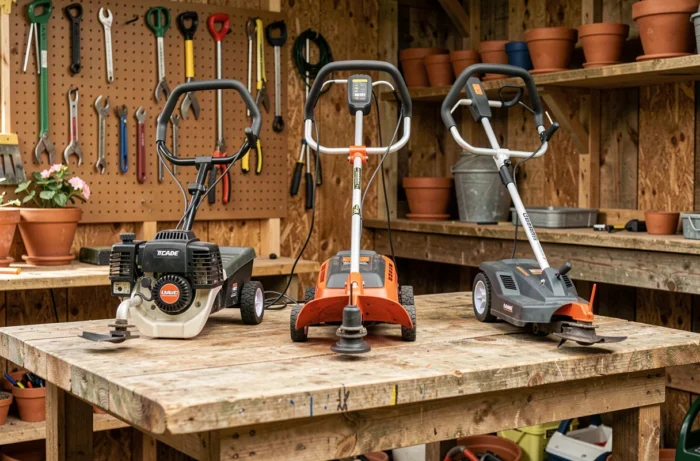
Ergonomics and harness: what changes fatigue on sloped terrain
Power and cutting system are not everything. On sloped or uneven terrain, the ergonomics of the machine becomes the decisive factor for the bearable working duration.
Two elements to examine before purchase:
The type of handle, first. A U-shaped handle distributes effort better across both arms and is suitable for mowing large flat areas. A D-handle offers more maneuverability in tight spaces, around trees, or along fences.
The harness, next. Entry-level models come with a simple shoulder strap, which concentrates weight on one side of the body. A double strap harness, or even a professional harness with a back plate, transfers weight to the hips and reduces neck fatigue. For a petrol machine weighing several kilograms, this accessory radically changes user comfort.
Maintenance and availability of parts: a purchase criterion in its own right
A point that traditional buying guides treat as an after-sales question deserves to be raised before purchase. The ease of maintenance and the availability of spare parts determine the actual lifespan of the machine.
On a petrol brush cutter, routine maintenance operations include replacing the air filter, checking the spark plug, and oil changes (on four-stroke models). If these parts are not easily found, the machine ends up at the back of the garage after two seasons.
For professional use, periodic checks and any anomalies must be recorded in a safety log. Checking the quality of the manufacturer’s distribution network (authorized repair centers, parts supply times) is part of the selection process, just like power or price.
On battery models, mechanical maintenance is reduced, but the longevity of the battery itself becomes the main replacement item. A quality battery retains its capacity over several hundred charge cycles.
The right reflex is to match the power suitable for your terrain with a network of accessible parts and maintenance locally, rather than choosing solely based on the technical sheet.