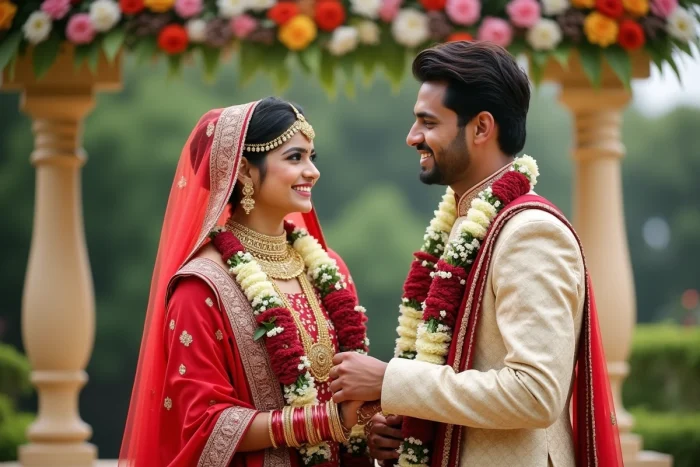
Red is not just a color in India: it is a statement. Draped in this symbol of fertility and prosperity, the bride asserts, through the embroidery, the strength of a millennia-old tradition. A few thousand kilometers away, in Kenya, the adornment becomes vibrant: a necklace of multicolored beads, a pledge of alliance, wraps around the necks of young Maasai couples. Finally, in Japan, sobriety prevails during the san-san-kudo, where the newlyweds and families bind their future by sharing three sips of sake, a solemn act that seals the alliance of two clans.
Depending on the cultures, marriage can summon a crowd or be experienced behind closed doors, governed by inherited gestures, sometimes confidential, passed down from generation to generation. Practices metamorphose, but each ritual carries the imprint of a history, the trace of a faith, the vision of an entire society.
Why are weddings celebrated so differently around the world?
Behind each wedding tradition lies a wealth of influences, beliefs, and ancient stories. The ceremonies do not resemble each other, so much so that they are shaped by the weight of family customs, laws, religious practices, and historical upheavals. At the heart of this patchwork: the family, a social matrix, which shapes the ceremony in its image. In India, the dower crystallizes the transmission and honor between families. The exchange of rings, a universal ritual, affirms a commitment without return.
Marriage is not just a matter of two people: it is a snapshot of a collective, a reflection of an identity. Rice is thrown to invoke abundance, henna is drawn to protect and bless the bride. Some societies impose their own rules: among the Tidong of Borneo, the newlyweds must refrain from using the toilet for three days, under penalty of attracting bad luck to their union.
Each custom finds its reason in the specific history of a people. Wars, migrations, religions leave their mark on rituals. Mariages du Monde focuses on these evolutions, these resistances, these fusions that constantly reinvent marriage. From country to country, creativity competes with fidelity to the past, offering a range of astonishing practices, sometimes bewildering, always deeply meaningful.
Here are a few examples illustrating this diversity:
- Rings: in many countries, they embody attachment and the promise of a shared life.
- Dower: in India, it formalizes the agreement between two families and their lineages.
- Throwing rice: a gesture shared across continents to wish for fertility and wealth.
- Tidong prohibitions: three days without toilets, a trial meant to protect the couple from bad omens.
Symbols, rituals, and jewelry: a dive into the richness of international wedding customs
Each wedding is a language woven with signs: jewelry, clothing, gestures. The exchange of rings embodies everywhere the oath of an unbreakable bond. The veil, placed on the bride’s head, distances the outside world, protects, intrigues, while emphasizing the solemnity of the moment.
Many wedding rituals illustrate the diversity of symbols:
- In Spain, the groom gives thirteen gold coins to the bride, a promise of sharing and daily support.
- In Orthodox Greece, crowns unite the spouses during a blessing, marking their sacred union.
- During henna ceremonies in India or the Middle East, the bride’s hands and feet are adorned with protective patterns, signs of future prosperity and happiness.
The wedding dresses also tell stories: the Moroccan bride changes outfits up to seven times throughout the celebration, each garment recalling a region or an ancestor. In Nigeria, the aso oke imposes its vibrant fabrics as a mark of belonging and family honor. In Japan, the sequence of kimonos celebrates the multiplicity of symbols and colors. Even the accessories carry their share of messages: a holey sock worn by the groom in Denmark, or banknotes sewn onto the Greek bride’s dress, are all winks at fidelity or the quest for prosperity.
A Western tradition, that of cutting the wedding cake together, marks the couple’s first shared action. In China, the tea ceremony unites families and generations, while the ubiquitous red envelope invokes luck and success. Across the globe, these wedding customs color each union with unique shades, reminding us of the depth of these commitments.
Unusual traditions that amaze and inspire: a world tour of the most remarkable wedding ceremonies
Marriage offers, everywhere, a ground of ritual imagination and daring symbols. From continent to continent, future spouses face unexpected trials and traditions that mark the entry into married life.
Here are some notable examples that testify to this inventiveness:
- In Brazil, the bride embroiders the names of her single friends on her dress, then places her golden heels on the dance floor: each guest slips in a bill, a gesture of support and a wish for prosperity.
- In Greece, a touch of sugar slipped into the bride’s glove promises sweetness and harmony in the home.
- In India, the ceremony is accompanied by a game: the groom removes his shoes in front of the altar, the bride’s family then tries to steal them, while his family tries to retrieve them, in a playful contest full of laughter.
- Among the Maasai, the father blesses his daughter by spitting on her head and chest, a mark of protection and respect.
Scotland dares the “blackening of the bride”: the future wife undergoes a deluge of flour, tar, and fish, meant to prepare her to face the challenges of marriage. In Germany, the Polterabend gathers friends and family to break dishes, ward off bad luck, and then clean up together in good spirits. In Japan, the San-San-Kudo is more subdued: three cups of sake are exchanged three times to unite two families and seal the marital promise.
Whether spectacular or discreet, these traditions tell of human inventiveness, the strength of the collective, and the ability to continually reinvent the paths of union. Through these rituals, marriage transcends time, borders, and continues to surprise those who partake in it… or simply those who discover them, elsewhere, on the map of the world.