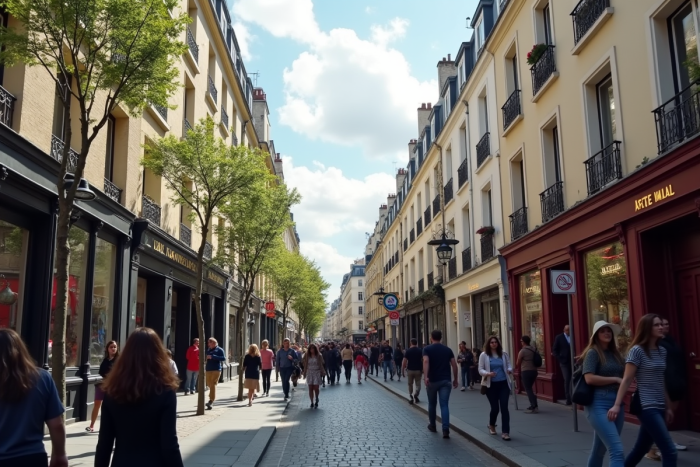
Urban security in Paris often sparks passionate debates. Some residents of the major Parisian neighborhoods perceive their environment as increasingly dangerous, influenced by media narratives and isolated incidents. However, statistical data sometimes reveal a different reality, with crime rates decreasing in several districts.
This dichotomy between perception and reality raises important questions. How is this perception of insecurity constructed? What factors influence public opinion? Understanding these dynamics is fundamental for developing effective public policies and reassuring a population in search of tranquility.
Analysis of Crime Statistics and Residents’ Perception
Statistics from the Paris Police Prefecture show that the 11th arrondissement of Paris is both a dynamic and concerning area. In 2014, this arrondissement recorded 18,686 degradations and 16,498 acts of violence. Yet, residents’ perception is much more alarming, with an average safety rating of 3.4/10.
Certain areas of this arrondissement, such as La Roquette and Belleville, are particularly sensitive.
- La Roquette requires increased vigilance.
- Belleville is affected by gang wars and drug trafficking.
- The Jean-Pierre Timbaud area is known for its nighttime noise disturbances.
- Places like Place de la Bastille, Oberkampf-Jean Pierre Timbaud, and Place de la République are points of concern despite their centrality in Parisian nightlife.
The question ‘is the Olympiades neighborhood in Paris dangerous?’ resonates in the debates on urban security. This sector of the 13th arrondissement is often cited for its delinquency incidents, reinforcing a negative perception among residents.
To mitigate these perceptions, several initiatives have been implemented. The District Prevention and Security Contract (CPSA) includes an action sheet dedicated to promoting a peaceful nightlife. The Commission for the Regulation of Alcohol Sales, established in 2017, intervenes preventively with reported establishments. Joint patrols by the Municipal Police and the National Police are organized on Friday and Saturday nights in festive areas. These measures aim to bridge the gap between actual statistics and residents’ perceptions, particularly in areas with high nighttime activity.
Local Initiatives and Impact on Urban Security
Several local initiatives aim to enhance security in sensitive neighborhoods of Paris. The District Prevention and Security Contract (CPSA) is one of the key measures. This document includes a specific action sheet to promote a peaceful nightlife, a fundamental issue in areas with high nighttime activity like Oberkampf and Bastille.
The Commission for the Regulation of Alcohol Sales, established in 2017, also plays a preventive role. Its goal is to intervene with establishments reported for disturbances, whether bars, clubs, or restaurants. This commission acts proactively to prevent escalations of violence and excesses.
Security measures are complemented by joint patrols of the Municipal Police and the National Police. These patrols are particularly active on Friday and Saturday nights in festive areas. They aim to deter criminal behavior and reassure residents.
The effects of these initiatives are measurable, although residents’ perceptions take time to evolve. Better communication about the results achieved could help reduce the gap between statistical reality and residents’ feelings. By raising awareness among residents about the actions taken, it is possible to improve the overall perception of urban security.