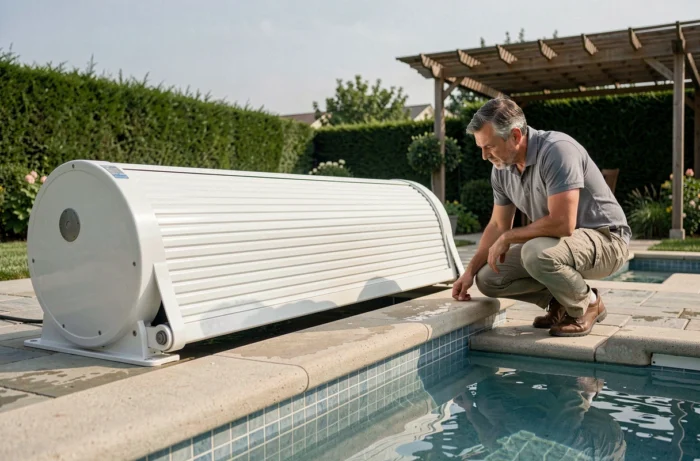
The load capacity of a pool roller shutter depends on several parameters that product sheets rarely summarize. The NF P90-308 standard imposes a minimum resistance threshold, but this threshold only reflects part of the mechanical reality of the system. The material of the slats, the quality of the anchors, the tension of the cover, and the configuration of the pool all modify the effective limit. Comparing these variables allows us to understand what a shutter can actually support and what it should never endure.
Resistance of pool roller shutter slats according to material
The cover constitutes the surface exposed to the load. Its composition largely determines the rigidity and the allowable deformation under point load.
| Type of slat | Main material | Relative rigidity | Deformation sensitivity |
|---|---|---|---|
| Standard PVC slat | Extruded PVC | Medium | High under prolonged static load |
| PVC slat with reinforcement | PVC + rigid core | Superior | Moderate |
| Polycarbonate slat | Hollow polycarbonate | High | Low to moderate |
| Solar polycarbonate slat | Tinted polycarbonate | High | Low to moderate |
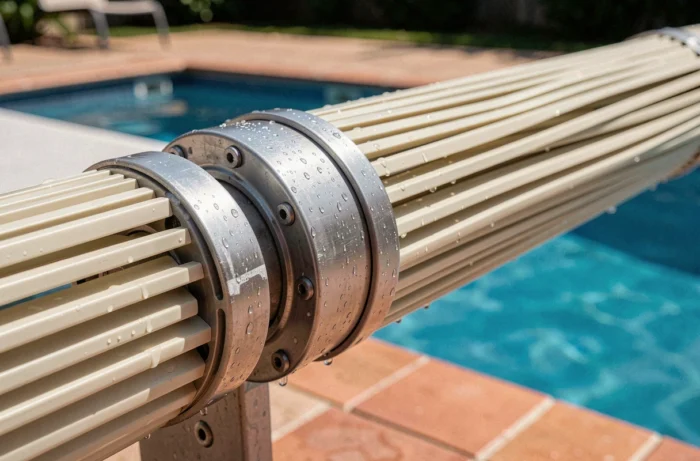
Polycarbonate slats offer better mechanical strength than simple extruded PVC. The presence of a central reinforcement in PVC slats reduces deflection under load, but does not fully compensate for the gap with polycarbonate over wide spans.
To understand the requirements related to the pool roller shutter safety standard, it is necessary to distinguish between the intrinsic resistance of the slat and the overall resistance of the installed system. A rigid slat mounted on poorly fixed rails or an undersized axle does not fulfill its safety function.
NF P90-308 standard and load threshold: what the 100 kg really means
The NF P90-308 standard sets a minimum resistance capacity of 100 kg for the safety test. This figure corresponds to a precise standardized test, not to a permission to use the shutter as a walkable surface.
The test verifies that the cover does not submerge under this load and remains attached to the pool. The cover must prevent access to the water for a child under five years old. In other words, the shutter must resist without yielding, not without deforming.
A nuance often overlooked: compliance pertains to the entire device. Anchors, locks, rails, straps, and the tension of the cover all contribute to the test result. A shutter sold as compliant can lose this qualification if the installation does not adhere to the manufacturer’s instructions.
- The water level in the pool modifies the tension of the cover and thus its ability to support a load without submerging.
- Cuts or obstacles on the coping can create weak points in the lateral locking.
- A poorly calibrated end-of-travel adjustment prevents the cover from reaching its nominal tension once unrolled.
Première Piscine specifies that compliance concerns the cover, the anchors, the straps, and their installation. A poorly tensioned model or one placed on an unsuitable support can lose its safety function, even if the product itself is certified.
Safety shutter or comfort shutter: a confusion that changes the load limit
Completely covering a pool is not enough to qualify a shutter as a safety device. Selectra indicates that only devices declared compliant with the NF P90-308 can be considered safety covers. A solar shutter or a bubble cover, even if motorized, do not fall into this category.
The difference has direct consequences on the allowable load. A comfort shutter is not subject to any standardized resistance threshold. Its structure is designed for thermal insulation or evaporation reduction, not to support the weight of a person.
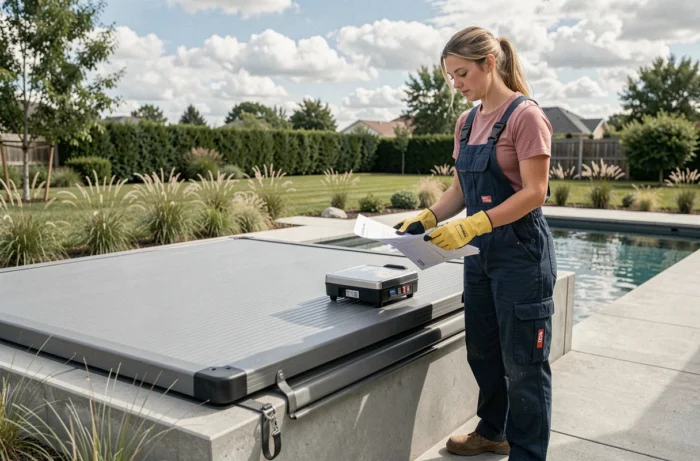
Above-ground, submerged, and solar shutters have distinct architectures. The submerged shutter, integrated into a pit at the end of the pool, benefits from a fixed axle and lateral rails that keep the cover under tension. The above-ground shutter, placed on the coping, rests on an external axle and peripheral fixings. Its stability depends more on the quality of the box and the fixing legs.
Submerged or above-ground shutter: impact on mechanical strength
The submerged shutter benefits from continuous guidance in rails embedded in the structure of the pool. This design distributes the load along the entire length of the cover. In contrast, an above-ground shutter fixed on added coping concentrates the forces on the anchoring points, which limits the tolerable point load.
The width of the pool also plays a role. The greater the span between the two rails, the more the deflection at the center of the cover increases under load. On a wide pool, even a compliant shutter can show visible deformation at the center without breaking.
Factors that reduce the actual capacity of the roller shutter over time
The resistance measured during certification corresponds to a new product, correctly installed. Several factors degrade this performance over the seasons.
- UV exposure weakens PVC slats, making them more brittle after a few years of intensive use.
- Limescale and chemical deposits clog the rails, increasing friction and reducing the effective tension of the cover.
- Repeated thermal shocks (winter freeze, summer sunshine) cause micro-cracks in polycarbonate slats.
- Insufficient maintenance of the anchors and straps compromises the integrity of the system long before the slats themselves give way.
Exceeding the recommended load, even temporarily, can lead to permanent deformation of the slats. Manufacturers generally do not guarantee the integrity of the shutter after an overload episode, which means that the actual limit decreases after each excessive stress.
The standardized threshold of 100 kg remains a design benchmark, not a ceiling for daily use. The effective resistance of a pool roller shutter depends as much on the quality of its installation and maintenance as on the material of its slats. Checking the tension of the cover, the condition of the fixings, and the proper functioning of the locking system each season remains the most reliable way to maintain load capacity over time.