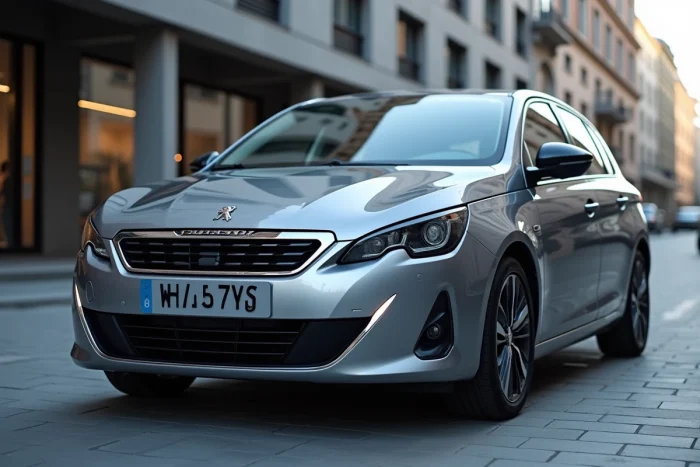
The gray color palette of the Peugeot 308 is not limited to a choice between “light” and “dark.” Each reference corresponds to a specific type of pigment, surface treatment, and pricing position within the Peugeot range. Understanding the differences between the grays allows for a trade-off between durability, repair costs, and residual value.
Gris Artense, Gris Platinium, Gris Selenium: composition and optical rendering
Each gray in the 308 catalog is based on a distinct pigment base. The Gris Artense uses aluminum particles oriented in a pearlescent binder, creating a depth effect that varies depending on the angle of light. The more neutral Gris Platinium relies on classic fine glitter metallization: the rendering remains stable regardless of the light.
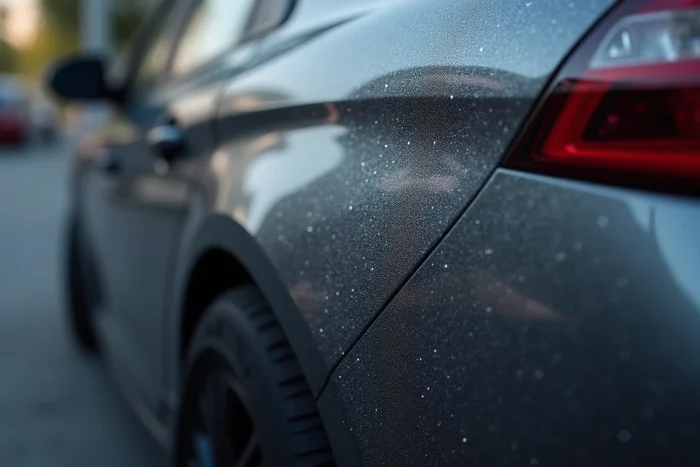
The Gris Selenium, offered on certain model years, is closer to a matte anthracite gray with a reduced metallic load. It absorbs more light and better conceals micro-scratches, but it visibly accumulates dust and water spots more than others.
The most common confusion arises between the pearlescent Gris Artense and the metallic Gris Artense. The pearlescent version incorporates mica pigments in addition to aluminum, adding a warm (almost golden) reflection in direct light. This variant is classified as special paint in the configurator, with an additional cost compared to the standard metallic version.
To better understand the differences between the grays of the Peugeot 308, one must also consider the impact on depreciation and maintenance.
Classification “special paint” and impact on insurer depreciation
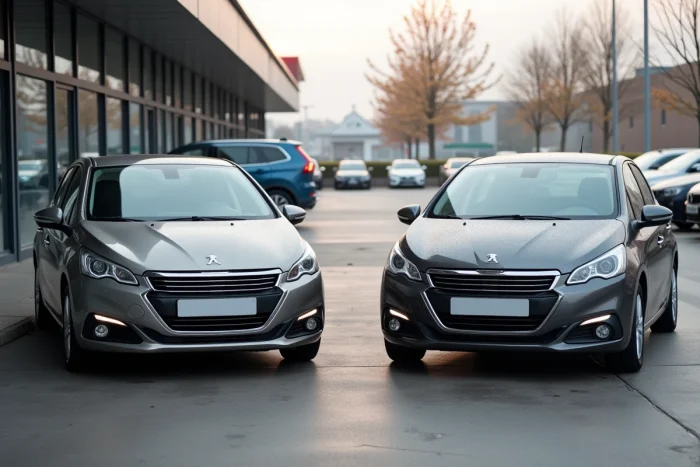
All metallic grays of the 308 are categorized as “special paint” or “metallic” in the depreciation grids of insurers. According to the reference of the National Alliance of Automotive Experts (2024 edition) and the color scale of BCA Expertise France 2024, metallic shades slightly reduce the estimated loss of value after a claim compared to a white or solid entry-level gray.
Specifically, during a post-claim assessment, the replacement value of a 308 in Gris Artense is calculated on a higher basis than a 308 in Blanc Banquise (opaque standard shade). This differential mainly affects company vehicles, where the contractual residual value at the end of a lease depends directly on the color scale applied.
Fleets and lease formulas: why technical grays dominate
The “Fleet and Mobility Barometer 2024” report from Arval France confirms that technical grays (Artense, Platinium) are the most chosen shades for fleet lease/LOA formulas. This choice is not aesthetic: technical grays favor better residual value at the end of the three to four-year lease. A fleet manager ordering in opaque white accepts a faster depreciation at resale.
Maintenance and micro-scratches: what changes from one gray to another
The sensitivity to micro-scratches depends less on the color than on the type of surface finish. A dark gray (Selenium, pearlescent Artense) makes swirl marks much more visible than a light gray (Platinium). User feedback on the Peugeot forum confirms that Gris Artense, despite its refined appearance, requires more regular maintenance to maintain its shine.
- Gris Platinium is more forgiving of automatic car washes due to its light shade and fine metallization that diffuses light.
- Pearlescent Gris Artense requires hand washing or at least a “high-pressure contactless” program to limit visible swirls.
- Gris Selenium, darker, conceals micro-scratches but retains water spots, necessitating careful drying after each wash.
We recommend applying a ceramic protection immediately upon delivery on pearlescent shades and dark grays. The initial cost is offset by the reduction in corrective polishing over the duration of ownership.
Grays of the 308 and resale value: what trade-off based on usage
The choice of gray depends on the anticipated resale scenario. An individual keeping their 308 for more than five years has little interest in overpaying for a pearlescent shade: the resale premium erodes with mileage and age. Conversely, for a short ownership (three years, a typical case of a lease), the additional cost of a metallic gray is almost fully recovered at resale.
In the used car market, grays represent the most sought-after color family for French compacts. Gris Artense and Gris Platinium sell faster than Bleu Vertigo or Rouge Elixir, simply because the pool of potential buyers is broader.
GT and GT Pack finishes: gray as a range marker
Peugeot prioritizes its “technical” grays on higher trims. The pearlescent Gris Artense, for example, is often associated with 308 GT and GT Pack in dealership demonstration configurations. This choice is not neutral: it creates a visual association between the shade and the level of equipment, facilitating the identification of the high-end model in the parking lot.
For a 308 Active or Allure, Gris Platinium remains the most coherent choice. It offers a refined appearance without the additional cost of pearlescent paint, and it pairs better with standard wheels (notably the 16-inch Topaze wheels, whose diamond treatment contrasts well with a light gray).
The right gray for a 308 is not necessarily the one that looks best on the configurator, but the one that matches the expected duration of ownership, the chosen trim level, and the owner’s actual tolerance for body maintenance. A Platinium on an Allure in a three-year lease remains the most rational option for the majority of buyers.