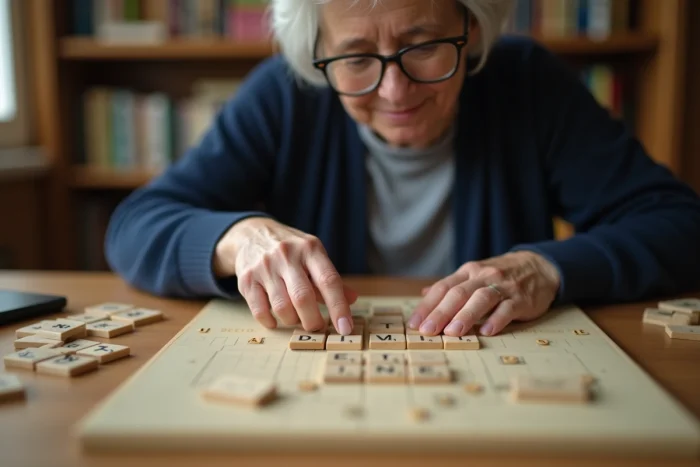
In Scrabble, two-letter words represent a tactical resource that many players underestimate. The word “in,” validated in the official French-speaking Scrabble dictionary, is one of those small units that can change the dynamics of a game. Two letters, two base points, but a placement potential that far exceeds this raw score.
Why “in” Changes the Management of High-Value Letters in Scrabble
You have a K, a W, or a Z on your rack, and the board seems locked? This is exactly the situation where “in” becomes useful. This two-letter word serves as an anchor point to place high-value letters on multiplier squares.
The principle is simple. You place “in” parallel or perpendicular to an existing word, creating an opening. This opening then allows you to place a high-value letter on a “triple letter score” or “double word score” square that was inaccessible in the previous turn.
Before “in” was added to the reference dictionary, competitive players had fewer options to exploit difficult draws. Now, “in” facilitates the placement of high-value letters by providing a very flexible two-letter support. The possibilities for “hooks” and parallels increase, especially in closed grids where openings are scarce. To delve deeper into the utility of the word in Scrabble, understanding parallel placements is a good starting point.
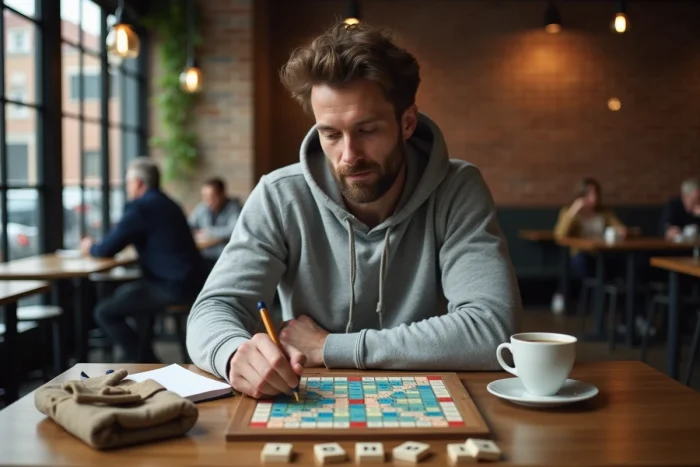
Defensive Blocking: Locking Bonus Squares with “in”
Scrabble is not just about scoring. It’s also a game of board control. And “in” excels in this defensive role.
When a “triple word score” square remains open, your opponent is watching it. Placing “in” nearby can neutralize that area. You occupy the space with minimal cost (only two letters leave your rack), while preventing a long and lucrative word from settling there.
Competitive players see this approach as a low-cost defensive blocking tool. Sacrificing two letters to block an opponent’s “triple word score” is often a profitable exchange. The key is timing: placing “in” too early wastes a resource, while too late leaves the opening for the opponent.
When to Use “in” Defensively Rather than Offensively
The decision depends on your rack and the position on the board. If you have a promising draw for the next turn, blocking with “in” preserves your options. If your rack is weak, blocking also limits damage while waiting for a better draw.
Here are situations where blocking with “in” is particularly effective:
- A “triple word score” square is accessible with a single word extension, and your opponent likely has long letters
- The grid is open on only one axis, and “in” allows you to close that axis without sacrificing high-value letters
- You are preparing for a Scrabble (placing all seven letters at once) in the next turn and need to buy time
Reopening a Closed Grid Late in the Game with “in”
Endgames in Scrabble present a recurring problem: the board closes, openings disappear, and players find themselves exchanging letters or placing low-value words. “In” changes this dynamic.
In situations of blockage or scarcity of openings, “in” serves to reopen the grid through small hooks. You create a support point that you or your opponent can exploit. The calculation is as follows: if your rack is better than your opponent’s, reopening the grid benefits you.
Parallel Placement Technique
The most cost-effective method is to place “in” parallel to an existing word, so that each letter forms a new two-letter word with the adjacent letter. For example, placing “in” next to “la” can simultaneously create “il” and “na” (if those words are valid in your setup).
Each letter of “in” must form a valid word with its neighbor. This is the condition for the parallel placement to be accepted. This technique multiplies points, as you score for “in” and for each crossing word formed.

Incorporating “in” into Your List of Two-Letter Words in Scrabble
Two-letter words form the technical foundation of competitive Scrabble. “In” joins a family of short words that every regular player should know by heart: QI, EX, or XI.
“In” is considered a weapon on par with QI or EX by competitors. Not mastering it means depriving yourself of options in critical moments of the game.
To effectively memorize these short words, a combination-based approach works well:
- Pair each vowel with compatible consonants to form valid two-letter words (I+N, but also the words that “in” allows you to create in hooks)
- Practice on real board positions rather than on abstract lists, as the spatial context anchors memory
- Systematically check two-letter words in the official Scrabble dictionary (ODS) before playing them in serious games
The Hooks of “in” to Know
A hook is a letter added before or after an existing word to form a new word. “In” accepts several extensions: “fin,” “pin,” “vin” by adding a letter in front, or “Inn” does not work, but other combinations exist according to updates to the official dictionary.
Checking valid hooks in the ODS remains the only reliable method. Online lists may be outdated if the dictionary has been updated in the meantime.
The word “in” will not alone transform an average player into a champion. But combined with good board reading and rigorous rack management, it adds a layer of tactical flexibility that makes a difference in tight games. The two shortest letters in the game deserve a place in your strategic arsenal.